1 Your practice2 Contact3 Calendar

About your practice

Which products are you interested in? Select all that apply
What software does your firm use? Select all that apply
Select your software
Document collection to ATX effortlessly & accurately!

Import Client docs to ATX —without retyping.

Bring every client document into one organized record—from the office kiosk, website, email, or text. AI Front Desk and CRM use prior returns and conversations to identify what is missing and follow up through the channels your firm chooses.

TaxAutomate automates ATX data entry from client documents by building a bookmarked PDF binder and, after your preparer approves the source values, entering supported data in the real ATX screens. Your preparer verifies the entry and finishes the return.

You control the follow-up. Your preparer controls approval, final review, and filing.

ATX Main Names
Approved
in binder
Entering
in ATX
Approved source → ATX entry → preparer review.Walk through ATX with our team.
ATX walkthroughWatch TaxAutomate enter data in ATXClient documents, automated entry, and review.Book a demo to see it →

Five connected steps to automated ATX data entry.

Start by gathering every client document into one complete file. TaxAutomate helps collect what is missing, builds the workpaper binder, routes values for approval, and performs the supported ATX entry. Your preparer verifies the entry and finishes the return.

1

Gather every client document in one place.

Start with one complete client file. Documents can arrive through your office kiosk, website, email, phone, or text, and every reply and upload stays with the same client record. TaxAutomate’s AI Front Desk and CRM help your team get there: they compare what has arrived with the prior-year return, open requests, and past conversations to identify what is still missing. The AI can follow up automatically, but your team chooses the pace, timing, and channels—and can pause, change, or take over any conversation.

The goal is one complete client file. AI helps your team get there.

TaxAutomate bringing client documents and conversations from every approved channel into one client record
Every channel → one client recordAI helps identify and request what is missing
2

TaxAutomate turns the document mess into an indexed PDF workpaper.

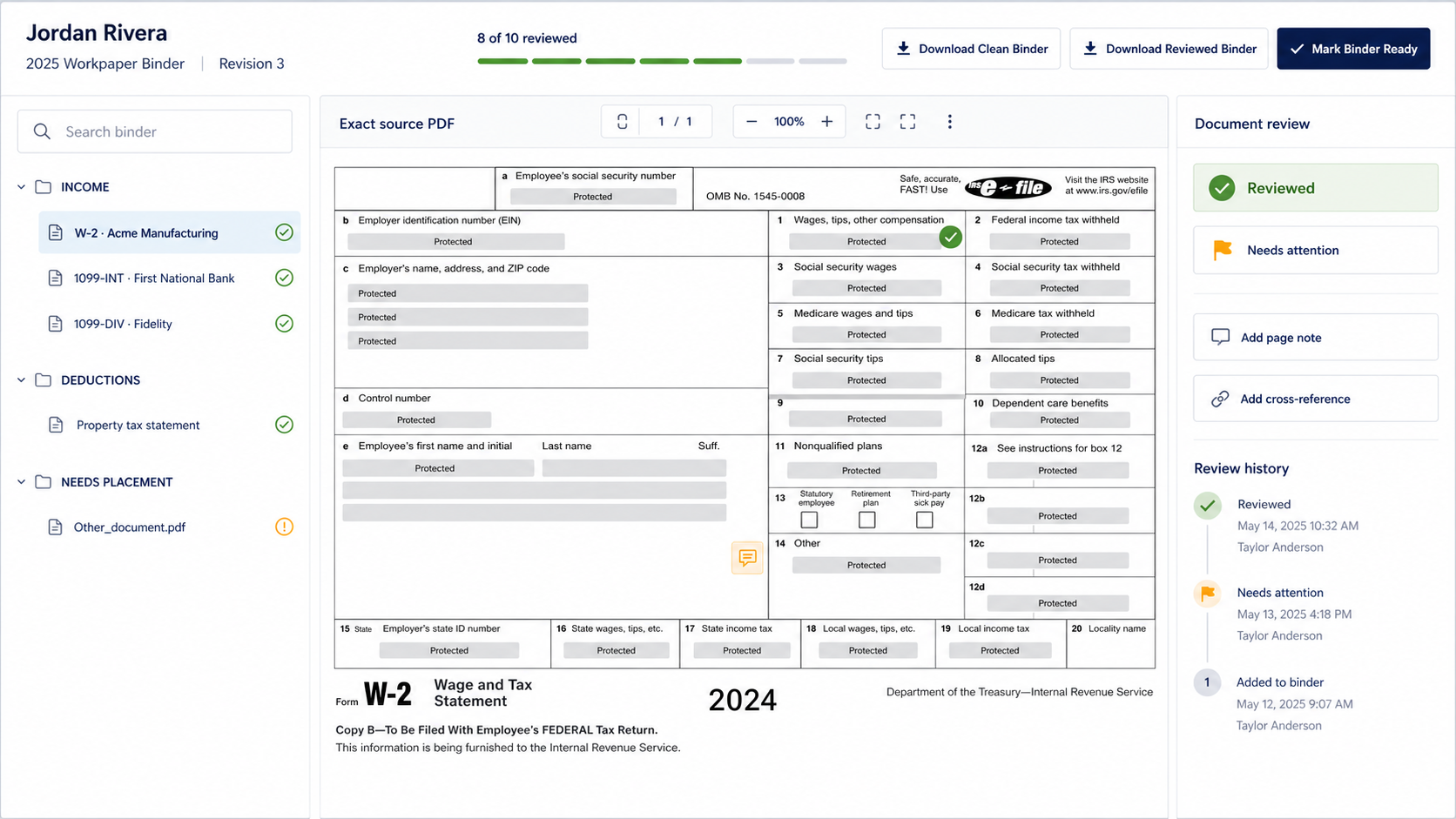
As files arrive, the software identifies and organizes the source documents, groups related pages, and builds one labeled, bookmarked PDF binder. Prior-year context and open requests remain attached to the same client record. Your team can rename, reorder, or regroup documents before marking the binder ready for review.

The software organizes it. Your team controls the final binder.
Bookmarked TaxAutomate workpaper binder showing a full W-2 PDF page
Documents identified and groupedBookmarks make every source easy to find
3

Self-check every value against the original PDF.

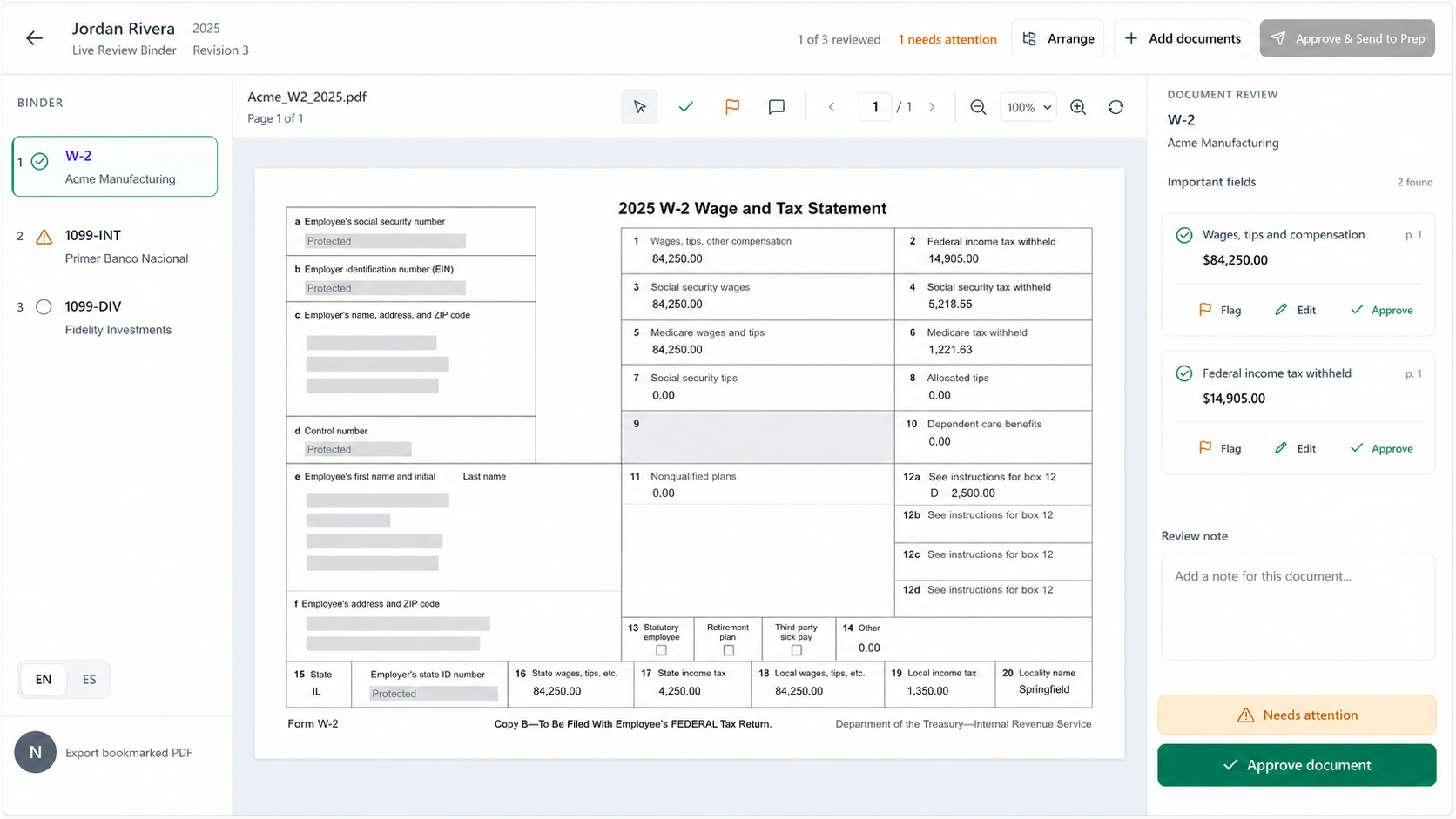
The split-screen review keeps the source document beside the extracted fields. Select a value and TaxAutomate brings its exact source area into focus. Your preparer can correct an OCR read, change a document classification, regroup pages, approve the value, or flag it.

Every approved value stays linked to its source.
TaxAutomate split-screen PDF review with extracted fields and source-area highlighting
Select a field → focus its sourceCorrect, regroup, approve, or flag
4

TaxAutomate enters approved data in ATX.

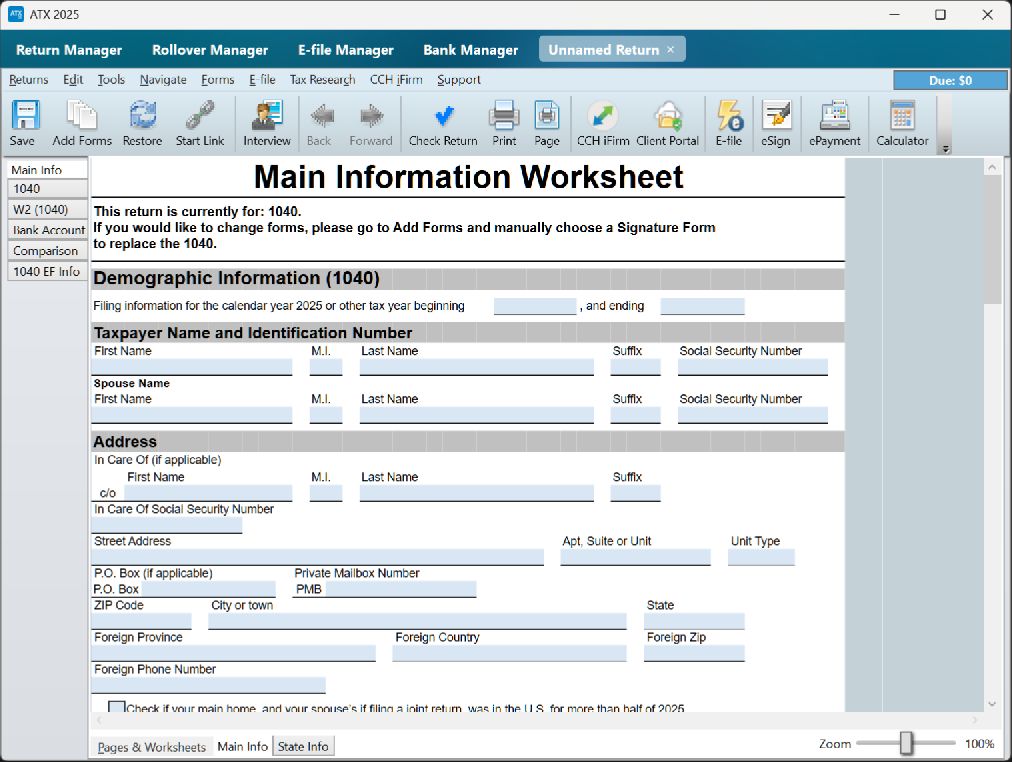
Your preparer does not retype the approved values. After approval, TaxAutomate opens the correct ATX screens on the paired Windows workstation and automatically enters each supported value into the matching field.

The software performs the supported data entry—not your staff.
TaxAutomate source-linked values approved before ATX entry
Approved binder valuesATX approved data entry
5After ATX data entry

Your preparer verifies the entry and finishes the return.

After TaxAutomate performs the supported data entry, the approved binder value and entered ATX value are presented side by side for your preparer. Your preparer confirms correct entries, resolves anything missing or different, reviews ATX’s calculations and diagnostics, handles unsupported items, applies professional tax judgment, completes the final review, and controls filing.

✓

Your preparer confirms the entry

Compare the approved source with the entered ATX field and confirm that it is correct.

×

Your preparer resolves discrepancies

Correct missing or different values and resolve ATX diagnostics or unsupported items.

Your professional finishes the return

Make the final tax decisions, approve the completed return, and control filing.

Automation with firm control

TaxAutomate does the work. Your professionals make the decisions.

TaxAutomate brings each client’s documents into one record. AI Front Desk and CRM help identify and request what is missing, and the software organizes the file and performs supported data entry within the rules your firm sets. Your preparer verifies the ATX entry, resolves exceptions, reviews diagnostics, applies tax judgment, completes final review, and controls filing.

1
You control the AI’s pace and channels.Choose when it follows up, where it communicates, and when a staff member takes over.
2
You control every approval and exception.Correct, regroup, approve, reject, or stop work before data enters ATX.
3
You control verification, final review, and filing.Your preparer verifies the entry and your authorized professional controls the completed return.
Where the automation runs

TaxAutomate operates the real ATX software for you.

Your firm pairs the Windows workstation that runs ATX with TaxAutomate. The software—not your preparer—opens the correct ATX screens and enters each supported approved value. The approved source and entered value are then presented for your preparer to verify. TaxAutomate's ATX connector runs on your paired workstation and enters approved, supported values into the configured ATX workflow.

Clear responsibilities

How ATX data entry automation works—and what your team controls.

TaxAutomate performs the repetitive work. Your firm sets the rules and retains every professional decision.

How are client documents gathered into one place?

Documents received through your office kiosk, website, email, phone, or text stay with one client record. AI Front Desk and CRM then help your team identify and request what is still missing.

How does the AI know which documents are missing?

AI Front Desk and CRM use the client record, prior return, documents already received, open requests, and conversation history to maintain a client-specific checklist. The checklist updates as replies and uploads arrive.

Can our team control the follow-up?

Yes. Your team chooses the cadence, timing, and allowed channels, including office kiosk, website, email, phone, and text. Staff can pause, change, or take over a conversation at any time.

Do extracted numbers go straight into ATX?

No. TaxAutomate organizes and extracts the information, but your preparer reviews the source and approves the supported values first.

Who performs the ATX data entry?

TaxAutomate does. After approval, the software opens the real ATX screens on the paired Windows workstation and automatically enters supported values into the matching fields. Your staff does not retype them.

Who verifies the ATX entry?

Your preparer does. The approved source and entered ATX value are presented side by side so your preparer can confirm the entry or resolve anything missing or different.

What if someone changes a source document?

TaxAutomate detects that the binder revision changed. The old run cannot move forward; the current documents must be reviewed and approved again.

Who makes the final tax decisions and files?

Your authorized tax professional does. TaxAutomate performs supported automation, but it does not verify the ATX entry, exercise tax judgment, complete final review, or file the return for your firm.

How does TaxAutomate connect to ATX?

The TaxAutomate ATX integration uses a paired Windows connector. Configure it for the workstation and ATX environment your preparer uses, then verify the supported data-entry workflow with a representative client file.

What should our preparer check in ATX?

Check the client and tax year, the approved values entered into the supported ATX fields, and any remaining diagnostics or unsupported items. Your professional reviews the completed return and controls filing.

See the unified workflow

Book a demo to watch TaxAutomate do the work.

Bring client documents into one record, review the bookmarked binder, and see TaxAutomate perform supported ATX data entry before your preparer verifies and completes the return.

Gather every client document in one recordReview the bookmarked PDF binderWatch the ATX handoffSee preparer verificationKeep final review and filing with your firm